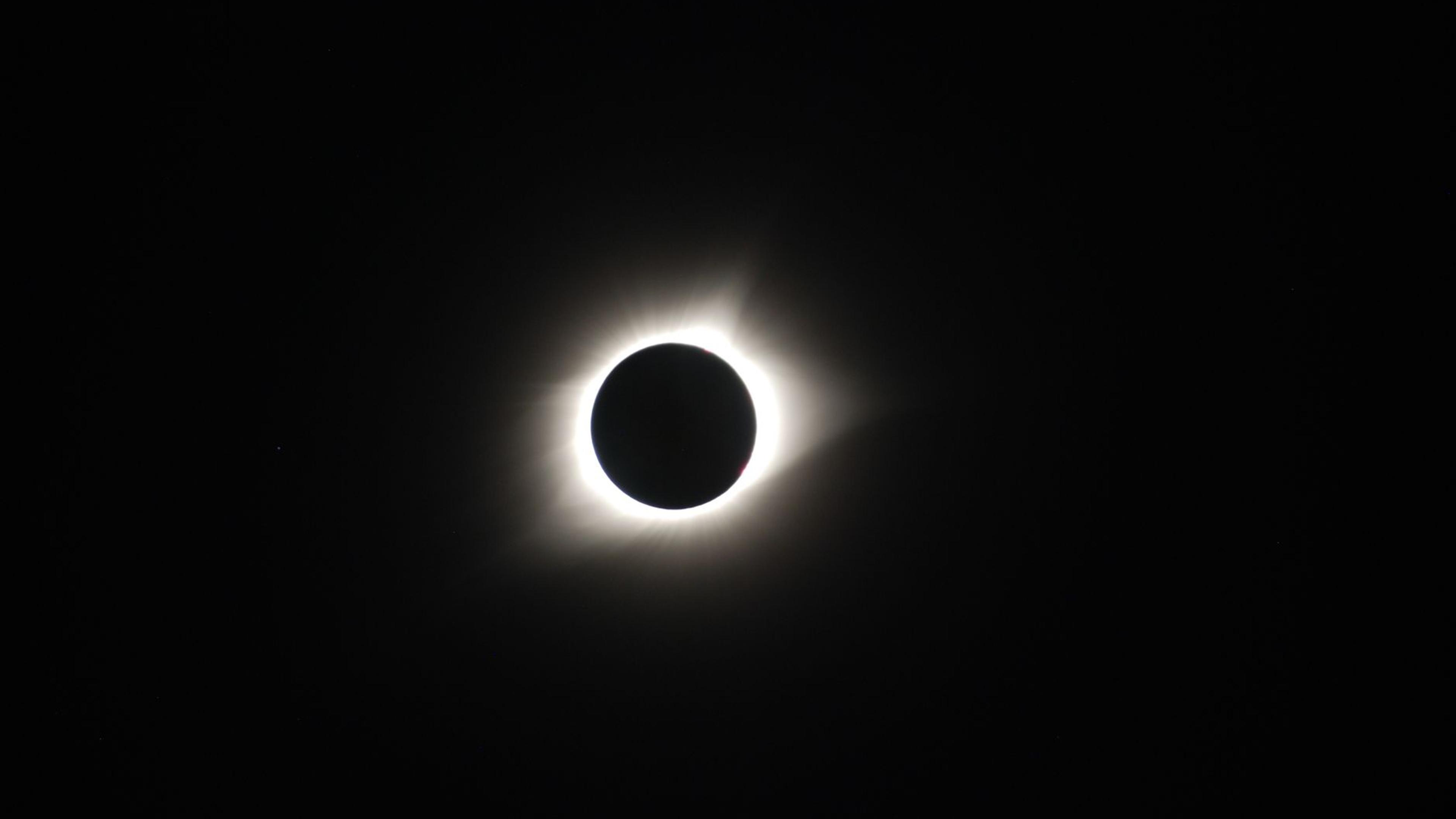
The 2 August 2027 eclipse starts in northern Morocco at about 08:40 Morocco time (UTC+1). Totality begins at 09:44 in Tangier, 09:45 in Tetouan and Chefchaouen, 09:46 in Al Hoceima and 09:48 in Nador, and the eclipse is over everywhere by about 11:07.
Below are the full times for every Moroccan town in the path, the partial eclipse elsewhere in the country, and how to use them to plan the morning. For what the eclipse is and how to plan a trip, see our complete Morocco eclipse guide. To explore the path on a map, use the interactive 2027 eclipse map.
How to read eclipse times
Eclipse timetables use four contact times. C1 (first contact) is when the Moon first touches the Sun’s edge and the partial eclipse begins. C2 (second contact) is the start of totality. C3 (third contact) is the end of totality. C4 (fourth contact) is when the Moon leaves the Sun and the eclipse is over. Maximum eclipse falls midway through totality.
You need eclipse glasses from C1 to C2 and from C3 to C4. Between C2 and C3 it is safe, and essential, to take them off. Our eclipse safety guide explains why.
Totality times for northern Morocco
| Town | C1 | C2 | Max | C3 | C4 | Totality |
|---|---|---|---|---|---|---|
| Larache | 08:40:02 | 09:44:20 | 09:46:29 | 09:48:38 | 10:59:49 | 4 min 18 s |
| Asilah | 08:40:15 | 09:44:21 | 09:46:43 | 09:49:06 | 11:00:01 | 4 min 44 s |
| Tangier | 08:40:32 | 09:44:38 | 09:47:03 | 09:49:29 | 11:00:20 | 4 min 51 s |
| Ksar el-Kebir | 08:40:06 | 09:44:52 | 09:46:43 | 09:48:34 | 11:00:14 | 3 min 42 s |
| Ouazzane | 08:40:13 | 09:45:44 | 09:47:02 | 09:48:19 | 11:00:47 | 2 min 35 s |
| Tetouan | 08:40:45 | 09:45:07 | 09:47:32 | 09:49:58 | 11:01:07 | 4 min 51 s |
| Chefchaouen | 08:40:36 | 09:45:25 | 09:47:31 | 09:49:38 | 11:01:18 | 4 min 13 s |
| M’diq | 08:40:50 | 09:45:11 | 09:47:37 | 09:50:04 | 11:01:11 | 4 min 53 s |
| Fnideq | 08:40:54 | 09:45:14 | 09:47:38 | 09:50:03 | 11:01:07 | 4 min 50 s |
| Al Hoceima | 08:41:35 | 09:46:58 | 09:49:10 | 09:51:23 | 11:03:35 | 4 min 26 s |
| Nador | 08:42:18 | 09:48:19 | 09:50:25 | 09:52:33 | 11:05:21 | 4 min 14 s |
| Saïdia | 08:42:49 | 09:49:19 | 09:51:19 | 09:53:19 | 11:06:36 | 4 min 00 s |
| Oujda | 08:42:55 | 09:51:11 | 09:51:39 | 09:52:09 | 11:07:16 | 0 min 58 s |
The longest totality in Morocco is on the coast north of Tetouan: 4 minutes 53 seconds at M’diq. Towns near the edge of the path get much less. Ouazzane, near the southern limit, gets 2 minutes 35 seconds, and Oujda only 58 seconds.
Partial eclipse times elsewhere in Morocco
Outside the path, the Moon never quite covers the Sun. The figure in the last column is the share of the Sun’s disc covered at maximum eclipse.
| Town | Starts | Maximum | Ends | Sun covered |
|---|---|---|---|---|
| Rabat | 08:39:03 | 09:45:18 | 10:58:37 | 98.6% |
| Fes | 08:40:18 | 09:47:30 | 11:01:47 | 98.4% |
| Meknes | 08:39:52 | 09:46:48 | 11:00:50 | 98% |
| Casablanca | 08:38:24 | 09:44:17 | 10:57:19 | 97.1% |
| Marrakech | 08:37:36 | 09:43:14 | 10:56:16 | 89.1% |
| Essaouira | 08:36:29 | 09:41:11 | 10:53:14 | 89.1% |
| Merzouga | 08:40:24 | 09:48:10 | 11:03:24 | 86.3% |
| Ouarzazate | 08:38:12 | 09:44:21 | 10:57:59 | 85.9% |
| Agadir | 08:36:24 | 09:41:02 | 10:53:08 | 84.5% |
Even 98% is not totality. The sky stays bright, the corona stays hidden, and you need glasses throughout. If you can reach the path, go. Our where to watch guide compares the towns inside it.
Where the Sun will be
Totality happens with the Sun 38–42° above the horizon, a little south of due east (azimuth about 95°). It is higher the further east you go: 38° in Tangier, 39° in Chefchaouen, 41° in Nador. That is high enough to clear most hills and buildings, but check your spot has an open view east before the morning.
Morocco time on eclipse day
Morocco is on UTC+1 for most of the year and switches to UTC+0 only during Ramadan, which in 2027 falls in February and March. On 2 August 2027 Morocco is on UTC+1. Spain and Gibraltar are on UTC+2 in summer, so the same moment reads one hour later there: totality starts at 10:45 Spanish time in Tarifa. Our Spain or Morocco guide has the Spanish times.
What you will notice, minute by minute
For the first half hour after C1 the eclipse is invisible without glasses: the light looks normal. With about half an hour to go, shadows under trees turn into small crescents and the light takes on a flat, silvery quality. In the last ten to fifteen minutes the temperature falls, the sky deepens to a darker blue, and birds and animals start to behave as if evening were coming.
In the final minute, look west, behind you as you face the Sun. The Moon’s shadow arrives from that side, and the horizon darkens as it sweeps in at about 4,600 km an hour. Faint ripples of light, called shadow bands, sometimes run across pale walls and the ground. Then the last beads of sunlight break up along the Moon’s edge, a final flash forms the diamond ring, and totality begins. Glasses off.
During totality there is a sunset glow all around the horizon, Venus and the brightest stars appear, and the corona spreads out around the Moon. At C3 the sequence reverses with a second diamond ring. Glasses back on.
Why totality is shorter near the edges
Totality is longest on the centre line of the path and falls away towards its northern and southern limits. The drop is gentle at first and steep near the edge: Chefchaouen, about halfway from the centre line to the southern limit, loses less than 40 seconds compared with Tetouan, while Ouazzane, much closer to the limit, loses more than two minutes. If you are choosing between two towns of similar weather, pick the one closer to the centre line, which runs along the coast just north of Tetouan.
How these times were calculated
These times are computed from the Besselian elements and path table for the eclipse published by NASA’s Goddard Space Flight Center (eclipse predictions by Fred Espenak), using the standard method for local circumstances. Our totality durations match timeanddate.com for Tangier and Chefchaouen. They do not include the rugged profile of the Moon’s edge, which can move contact times by a few seconds, more near the edges of the path.
Planning around the clock
Plan to be at your viewing spot by 08:30, before C1 at about 08:40. That gives time to set up, find shade for the hour of partial eclipse, and settle in before totality. Have breakfast early; the riads will be busy. Afterwards, wait out the final partial phase if you like, and start any onward drive after about 11:00.
Our private tours are timed for this. The 10-day tour from Casablanca has a free morning in Chefchaouen on eclipse day, the 14-day Grand Morocco circuit spends two nights there, and the 12-day Grand Morocco tour from Marrakech is in Chefchaouen on day 8, eclipse morning, if you start on 26 July. See every option on the eclipse tours page.
Planning a Morocco tour? Browse our tours
See all tours →Quick answers
At 09:44:38 Morocco time (UTC+1) on 2 August 2027. It lasts 4 min 51 s. The partial eclipse begins at 08:40 and ends at 11:00.
The partial phase begins at 08:40, totality runs from 09:45:25 to 09:49:38 (4 min 13 s), and the eclipse ends at 11:01, Morocco time.
Fes sees a partial eclipse only. It begins at 08:40, peaks at 09:47 with 98.4% of the Sun covered, and ends at 11:01 Morocco time.
UTC+1. Morocco only moves to UTC+0 during Ramadan, which in 2027 is in February and March. Spain is an hour ahead at UTC+2.