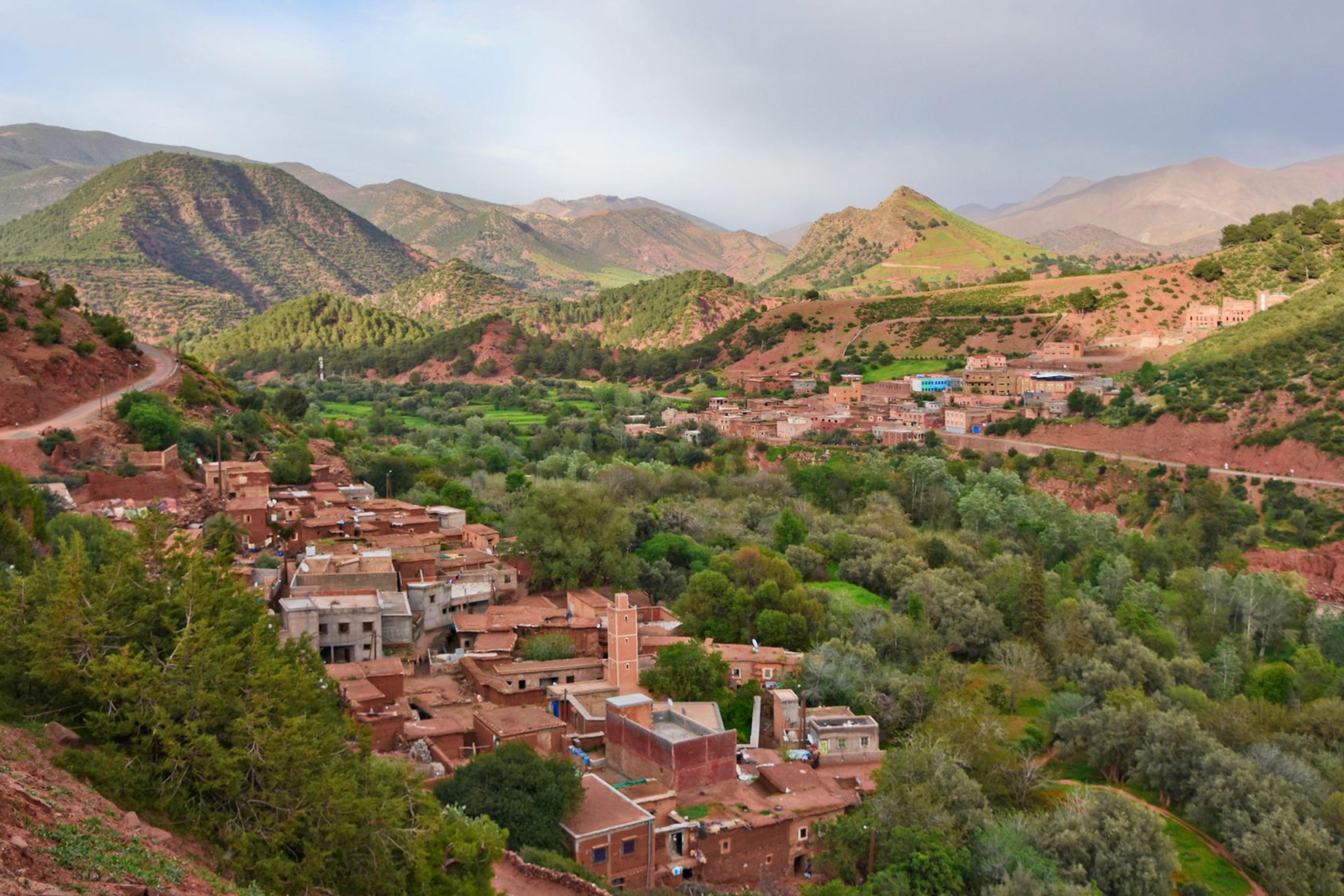
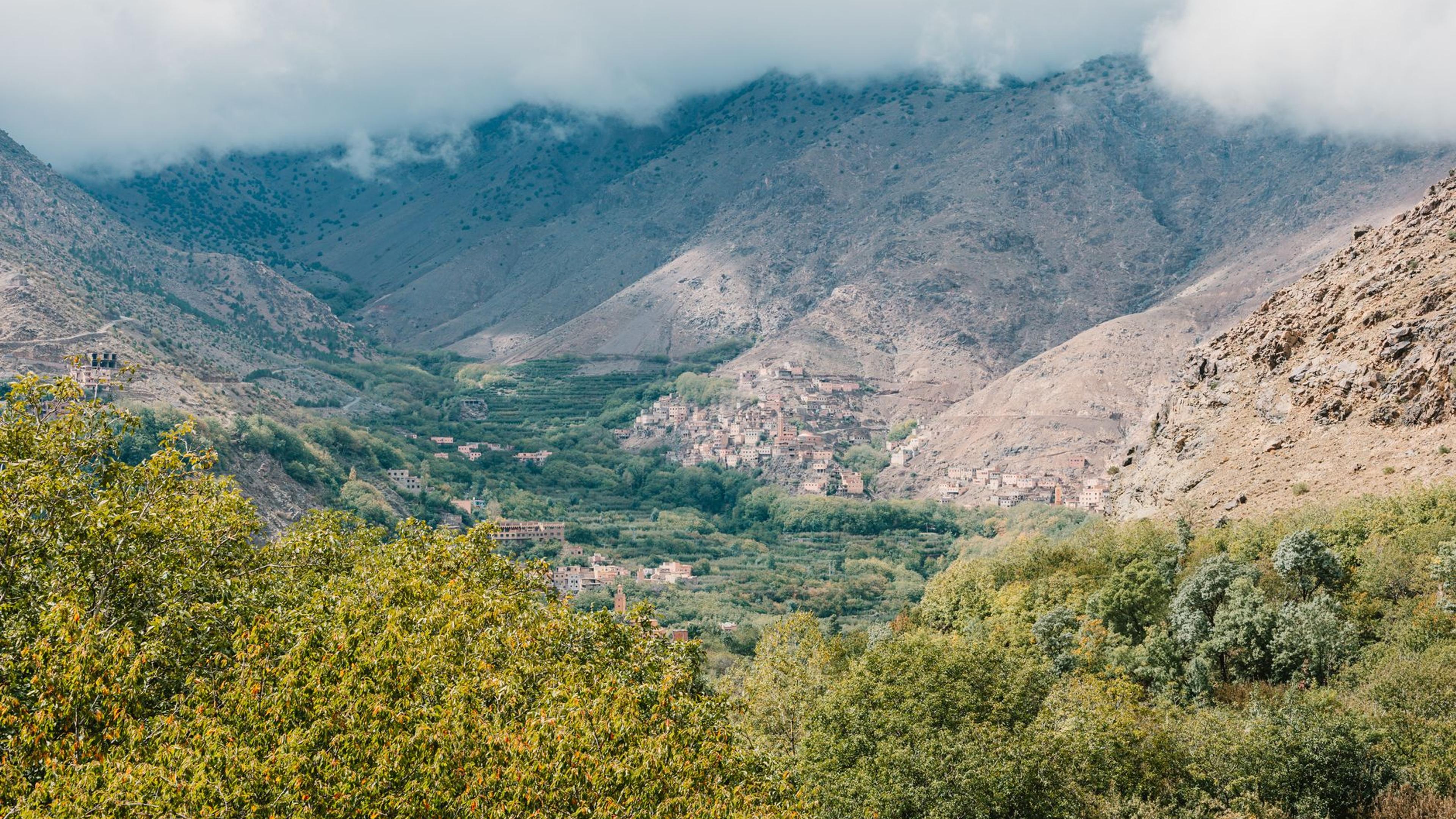
Trekking in the Atlas Mountains starts in one place for most people: Imlil, a village at about 1,740 m and roughly 90 minutes by road from Marrakech. From there you can walk easy mule paths between Berber villages in a single day, or climb Jebel Toubkal (4,167 m), the highest peak in North Africa, in two. The best months are April to June and September to October. Since 2019, trekkers heading up Toubkal have had to go with a licensed mountain guide, so plan for one from the start.
This guide covers the main routes, how hard each one really is, when to go month by month, what to pack, and how a guided trek works in practice.
Where do Atlas Mountains treks start?
Almost every first trek in the High Atlas starts in the Imlil valley. The road from Marrakech crosses the Haouz plain, climbs through Asni and ends in Imlil, a cluster of guesthouses, mule stables and walnut terraces at the foot of the Toubkal massif. It is the easiest trailhead to reach and the one with the best-maintained paths.
Two other bases are worth knowing about:
- Ourika Valley — about an hour from Marrakech. Good for a short walk to the Setti Fatma waterfalls, but busy at weekends and more of a day out than a trek.
- Aït Bouguemez — the so-called Happy Valley in the Central High Atlas, four to five hours from Marrakech. Quieter and greener, with multi-day routes towards Ighil M'Goun (4,071 m). It needs more days than most visitors have.
If this is your first time in the Atlas Mountains, start in Imlil. You get real mountain scenery, proper villages and a choice of easy or hard routes, all within reach of Marrakech.
The best Atlas Mountains treks, from easy to hard
The right trek depends on your fitness, your days and whether you want a summit or a walk through village life. These are the routes we recommend most.
1. Imlil village loop (easy, half day)
A 3–4 hour circuit from Imlil up to Aroumd (Armed), a village at about 1,900 m with views straight up the Toubkal valley, and back down through walnut and apple terraces. Paths are wide and mostly gentle. This is the walk to choose if you want a taste of the mountains without a big day.
2. Imlil to Tacheddirt via the Tizi n'Tamatert pass (moderate, full day)
A 5–6 hour walk over the Tizi n'Tamatert pass (about 2,280 m) into the next valley, with views back to the Toubkal ridge. You descend to Tacheddirt, one of the highest permanently inhabited villages in the area. This is the classic "real trekking day", and it is the kind of full day our 4-day Atlas Mountains trekking tour includes, with the route adjusted to each group's pace.
3. Three-valley trek (moderate, 2–3 days)
Link Imlil, Tacheddirt and the Ouirgane or Azzaden valleys over two or three days, sleeping in village guesthouses. Mules carry the bags, so you walk with a day pack. This is the best option if you want several days of walking without the altitude of Toubkal.
4. Jebel Toubkal summit (hard, 2 days)
The best-known Atlas Mountains trek. Day one is a 5–6 hour walk from Imlil to the Toubkal refuge at about 3,200 m. Day two starts before dawn with a 3–4 hour climb on scree to the 4,167 m summit, then the long descent to Imlil. No climbing skills are needed between late spring and autumn, but it is a genuinely hard day. In winter the upper mountain is snow-covered and needs crampons, an ice axe and winter experience.
Our honest take: Toubkal is a great goal if you are fit and have two spare days. If you are not sure, a valley trek usually gives you more mountain life for less suffering. The summit day is mostly loose scree, and the descent is hard on the knees.
How hard is trekking in the Atlas Mountains?
Most Atlas treks are walking, not climbing. The difficulty comes from altitude, steep ground and long days rather than technical sections.
- Easy routes (village loops, Ourika) suit anyone who can walk 3–4 hours with some uphill.
- Moderate routes (passes, multi-day valley treks) need a reasonable base: comfortable walking 5–6 hours a day with 600–900 m of climbing.
- Toubkal needs good fitness. Expect 1,450 m of ascent on day one and nearly 1,000 m on summit morning.
Altitude is the part people underestimate. Above about 3,000 m some walkers get headaches or poor sleep. That's why Toubkal is done over two days, and why we build a free afternoon in Imlil before any walking starts. If you are travelling with older family members, the valley routes and a slower pace work very well. Our Morocco tours for seniors follow the same approach.
When is the best time to trek in the Atlas Mountains?
The best months for trekking in the Atlas Mountains are April to June and September to October. Days are warm, nights are cool and the high paths are usually clear of snow. The month-by-month table below shows how each part of the year feels on the trail around Imlil.
Winter (December to February) is quiet and clear, but snow covers the high passes and Toubkal becomes a mountaineering objective. July and August are fine above 2,000 m, though the valleys are hot, afternoon storms build over the peaks, and Imlil is at its busiest. For the wider picture, including how the mountains fit with the desert and the cities, see our guide to the best time to visit Morocco.
What to pack for an Atlas Mountains trek
Pack for four seasons in a day. The valleys can be 25°C at lunchtime and near freezing at night at the refuge.
- Broken-in walking boots with ankle support (trail shoes are fine for village loops)
- A warm fleece and a light insulated jacket, even in summer
- A waterproof shell for spring and late-summer storms
- Sun hat, sunglasses and high-factor sunscreen — the sun is strong at altitude
- A 25–30 litre day pack and 2 litres of water capacity
- A head torch for the early Toubkal start
- Walking poles, especially for the Toubkal descent
Crampons, ice axes and poles can be rented in Imlil if your trek needs them. Our Morocco packing list covers what to bring for the rest of the trip.
Do you need a guide to trek in the Atlas Mountains?
For Toubkal, yes: since 2019 the local authorities have required trekkers to go with a licensed mountain guide. For lower village walks it is not always compulsory, but it is still the better choice. Paths split without signs, weather changes quickly, and a local guide opens doors that you would walk straight past — a family kitchen for mint tea, a village mosque at prayer time, the reason one terrace grows walnuts and the next grows barley.
On our trips the trekking days are led by licensed local mountain guides who grew up in these valleys. Your AZA driver-guide handles everything around them: the drive up from Marrakech, the guesthouse, the timing and the onward route. Mules and muleteers carry luggage on multi-day treks, which is standard practice in the High Atlas and a direct source of income for the villages.
Where do you stay on an Atlas Mountains trek?
Most treks use village guesthouses (gîtes) and small family-run lodges in and around Imlil. Rooms are simple and warm, dinners are home-cooked tagine and couscous, and the views are often better than the plumbing. On the Toubkal route you sleep one night in a mountain refuge in shared dormitories.
If you want more comfort, keep the mountain nights short and spend the rest in a Marrakech riad. Our private Marrakech and Atlas Mountains tour works this way: an Ourika Valley day trip, two nights in Imlil with a full trekking day, then back to Marrakech.
How to fit an Atlas trek into a Morocco trip
Imlil is close enough to Marrakech that a trek fits into almost any itinerary:
- One day: a village walk from Imlil with lunch in a Berber home, back in Marrakech by evening.
- Three to four days: Marrakech plus two nights in Imlil with a full trekking day, which is exactly our Atlas Mountains trekking tours.
- One week: mountains first, then the Sahara. The 7-day Atlas & Sahara adventure treks around Imlil, crosses the Tichka Pass to Aït Benhaddou and ends with a night in the Merzouga dunes.
Want to see how far each place is from the others before you decide? Our interactive Morocco map shows every AZA route on one screen.
Plan your Atlas Mountains trek
Every group walks at a different pace, so we shape the trekking days around yours rather than a fixed timetable. Tell us your dates, your fitness and whether Toubkal is on your list, and we'll build a trek around it.
Month-by-month at a glance
Planning a Morocco tour? Browse our tours
See all tours →Quick answers
For Jebel Toubkal, yes. Since 2019 the local authorities have required trekkers to go with a licensed mountain guide. For lower village walks around Imlil a guide is not always compulsory, but paths split without signs and the weather changes fast, so a local guide is still the safer and more rewarding choice.
Toubkal (4,167 m) is a non-technical climb from late spring to autumn, but it is a hard two days. Expect about 1,450 m of ascent from Imlil to the refuge, then a pre-dawn climb of nearly 1,000 m on loose scree to the summit and a long descent. Good fitness and a gradual start help with the altitude.
April, May, September and October are the best months for trekking in the Atlas Mountains. Days are warm, nights are cool and the high paths are usually free of snow. June is also good if you start early. Winter brings snow above 2,500 m, and July and August are hot in the valleys and busy in Imlil.
One day is enough for a village walk from Imlil. Two days covers a Toubkal summit attempt, and three to four days gives you a proper multi-valley trek with nights in village guesthouses. If you also want the Sahara, allow about a week so the mountains and the desert each get real time.
Yes. Imlil is about 90 minutes from Marrakech, so a half-day or full-day village walk with lunch in a Berber home fits easily into a day trip. You will not reach high passes or Toubkal in a day, but you will see the villages, the terraces and the Toubkal massif up close.
Yes, hiking in the Atlas Mountains is safe when you walk with a licensed local guide, which is also required for Toubkal. The main risks are the usual mountain ones: sudden weather changes, altitude above 3,000 m and loose scree on steep descents. Good boots, warm layers and a sensible pace deal with most of them.
Bring broken-in walking boots, a warm fleece, a light insulated jacket, a waterproof shell, sun protection, a 25–30 litre day pack, two litres of water capacity and a head torch. Walking poles help on the Toubkal descent. Crampons and ice axes can be rented in Imlil if your winter trek needs them.
Most treks use village guesthouses and small family-run lodges around Imlil, with simple warm rooms and home-cooked dinners. The Toubkal route adds one night in a mountain refuge with shared dormitories. For more comfort, keep the mountain nights short and spend the rest of the trip in a Marrakech riad.